Procida
Procida is one of the Flegrean Islands off the coast of Naples in southern Italy
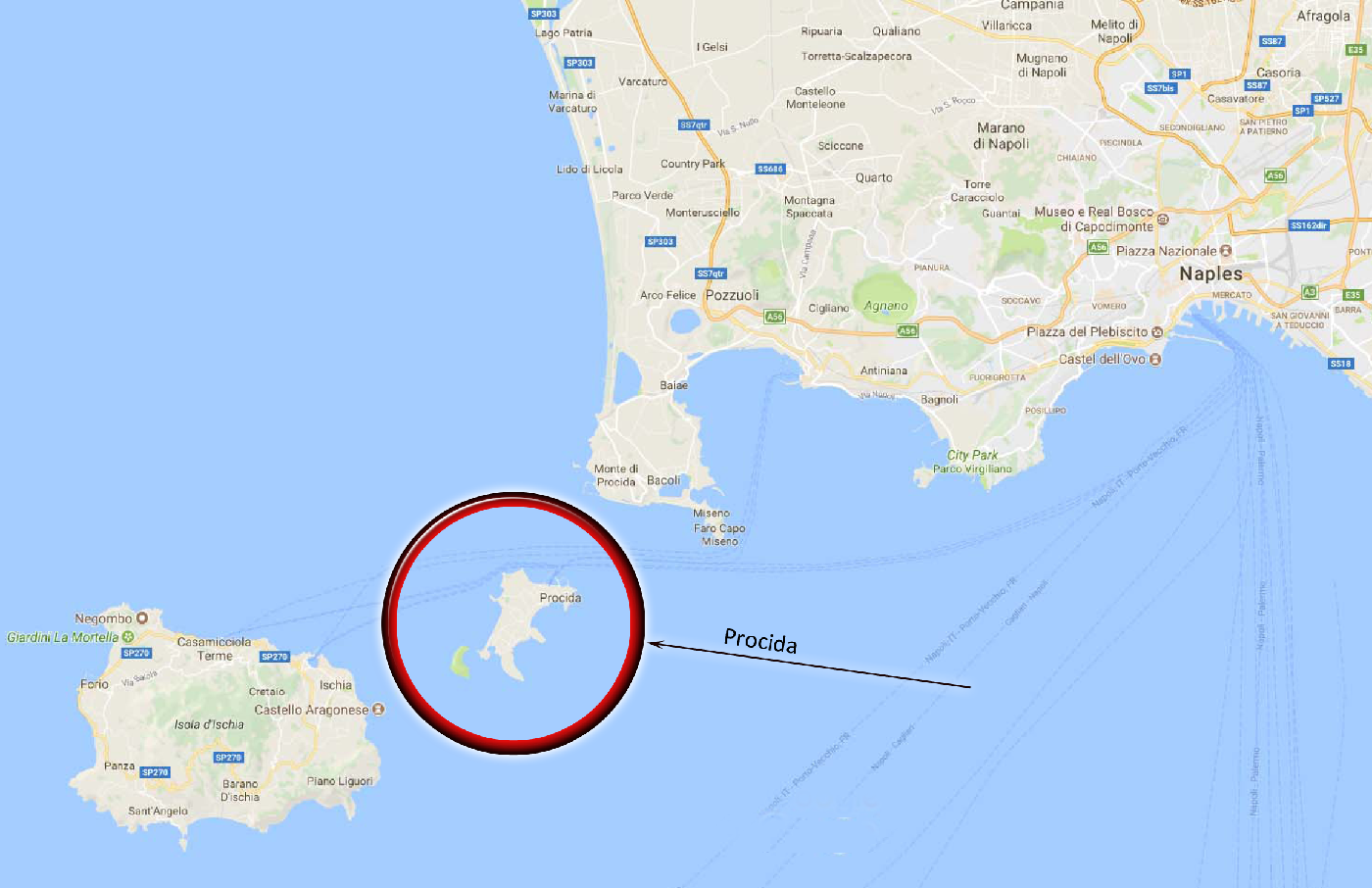
In 1816 Antonio and Lucia had a son: Nicola, the father of our great grandfather. About Nicola, we know that he was very tall and a sailor. Our aunts used to tell us he had a ship by the name of “Giovine Italia”. Nicola settled down in Procida, and on March 28, 1844, married Maria Bianco. Procida (Neapolitan: Proceta) is one of the Flegrean Islands off the coast of Naples in southern Italy. The island is between Cape Miseno and the island of Ischia. With its tiny satellite island of Vivara, it is a comune of the Metropolitan City of Naples, in the region of Campania.
From that union came 5 children; Antonio (our great grandfather – February 12, 1847), Letizia – January 8, 1849, Domenico Carmine – November 7, 1850, Angela Carmela – September 16, 1854 and Maria Luigia – April 23, 1858.
As the story goes, Nicola’s ship never returned from one of its voyages, leaving the family in extreme poverty; a widow with five children to feed. It was under these circumstances that our great grandfather, the oldest brother, was forced to face life and earn a living doing the only thing he knew about; sailing. This is how at the age of 13, he joined the crew on a British vessel.
As to his siblings, we have no information as to what happened to them. His mother, Maria Bianco, never got to see her son Antonio (our great grandfather) again, and died in Procida on January 27, 1900. A picture exists of her (which is in possession of my sisters), she is an old lady with a black scarf, typical Mediterranean woman.
I’m overcome with a feeling of tenderness when I think of her; she must have suffered in silence and resignation. She had given our great grandfather an icon of Saint Ana which was kept by our aunts in a crystal dome.
Unfortunately aunt Quita gave it to me in the presence of aunt Nene who at the same time asked me for it on loan. I wasn’t able to refuse, Nene took it with her to Montevideo and its anybody’s guess what happened to it after her death.
Our great grandfather’s life on the British ship was horrible. Despite being with a friend, the Brits treated them like dogs (and I don’t mean English dogs as they tend to be well treated), and were give only leftovers to eat. On one occasion there was a plague on the ship and our great grandfather and his friend (two children) were forced to throw the bodies overboard.
His only satisfaction was (as he had a magnificent voice) when the officers asked him to sing, he would sing the worst insults he could come up with in his local Neapolitan dialect, which was the only way he could get back at them without being punished.
In those days, the work contracts, and specially ones with the Navy, were time bound. The worker could not default on the contract before its completion. To prevent the crew from jumping ship, the British would dock far from the coast, and then supply the ship using row boats.
On a certain day, the ship anchored close to the port of Montevideo. Our ancestor and his friend, tired of the slave like life, slipped down the anchor chain during the night and swam to shore.
Thus begins our family history in Argentina. . . .
Procida is one of the Flegrean Islands off the coast of Naples in southern Italy